
Event Detail
- Start Date 09/07/2026
- Start Time 12:00 AM
- End Time 11:55 PM
- Location INDONESIA
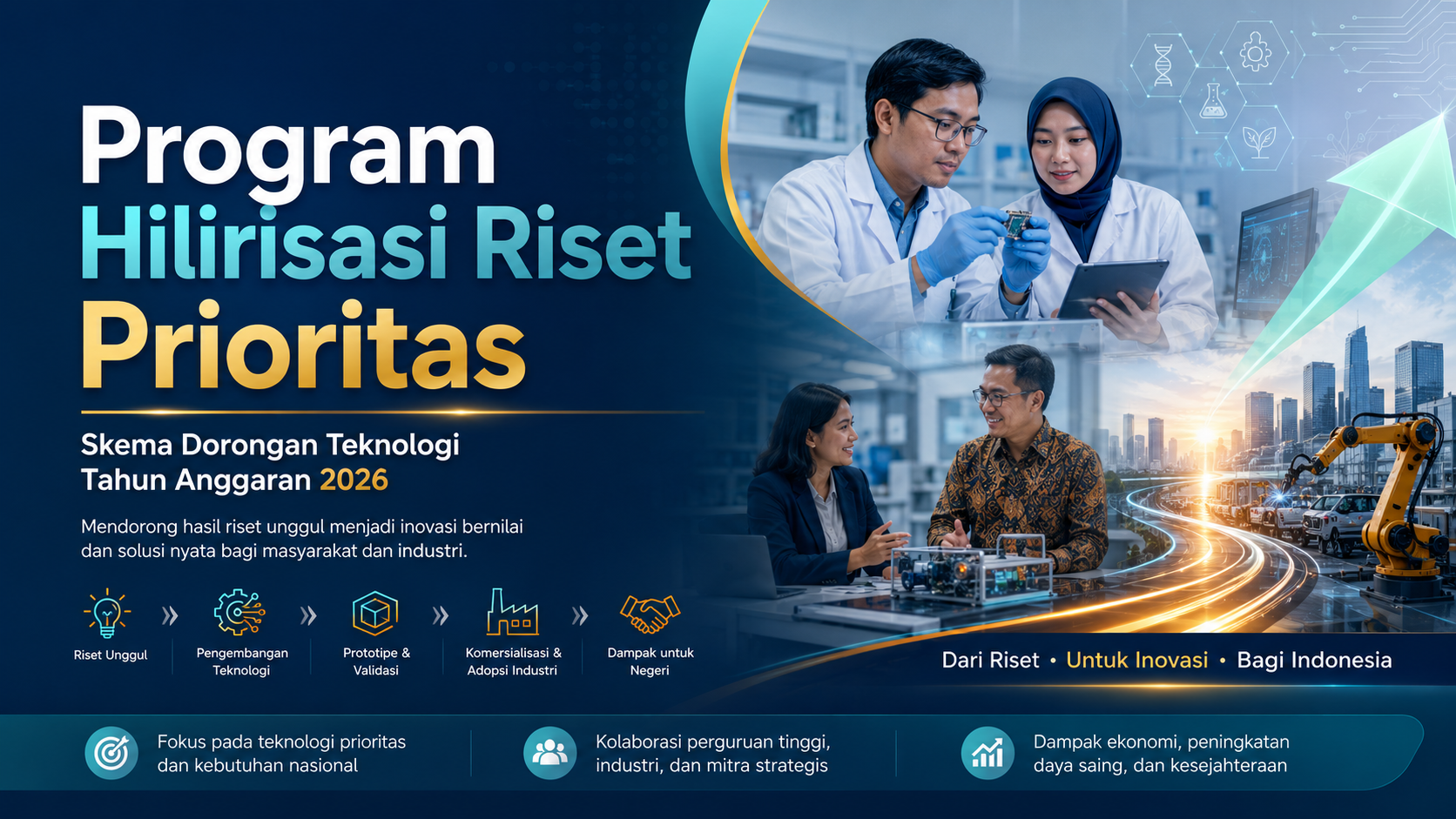
Program Hilirisasi Riset Prioritas through Skema Dorongan Teknologi is designed to accelerate the transition of university research outputs from academic findings into innovations that are feasible for implementation, production, or use by industry and society. Its primary focus is not merely to generate new research, but to systematically assess whether an existing technology offers clear technical advantages, has reached an adequate level of readiness, responds to an identifiable user need, and possesses a realistic development pathway. Through the preparation of a Pre-Feasibility Study, universities are encouraged to identify the problem addressed by the technology, compare the proposed solution with existing alternatives, map prospective users and partners, estimate investment requirements, and evaluate regulatory, production, supply-chain, intellectual-property, and market-acceptance barriers. In this way, the program serves as a bridge between the academic research culture and practical implementation needs, while helping universities determine whether a research output should proceed to further testing, demonstration, technology transfer, licensing, start-up formation, or commercial collaboration.
Prospective applicants should provide evidence that the proposed product or technology genuinely originates from research, has a documented development history, and is supported by verifiable technical data. The proposal should present the technology profile, technology-readiness level, distinctive value, intellectual-property status, user-problem analysis, market characteristics, prospective partners, testing plan, implementation risks, cost structure, and a post-program downstream-development roadmap. Proposal strength will largely depend on the consistency among the problem being addressed, technological maturity, team competence, partner involvement, and promised outputs. Applicants must also ensure that the budget is directed toward activities that directly support feasibility analysis and technology validation rather than routine activities unrelated to downstream development. The expected outcome is a feasibility document that can support decision-making, negotiations with industry, and applications for follow-on funding. For this reason, the team should ideally combine technical, business, intellectual-property, legal, and industry expertise so that the resulting analysis is not only academically sound but also operational and actionable.