


Event Detail
- Start Date 01/07/2026
- Start Time 12:00 AM
- End Time 12:00 AM
- Location INDONESIA
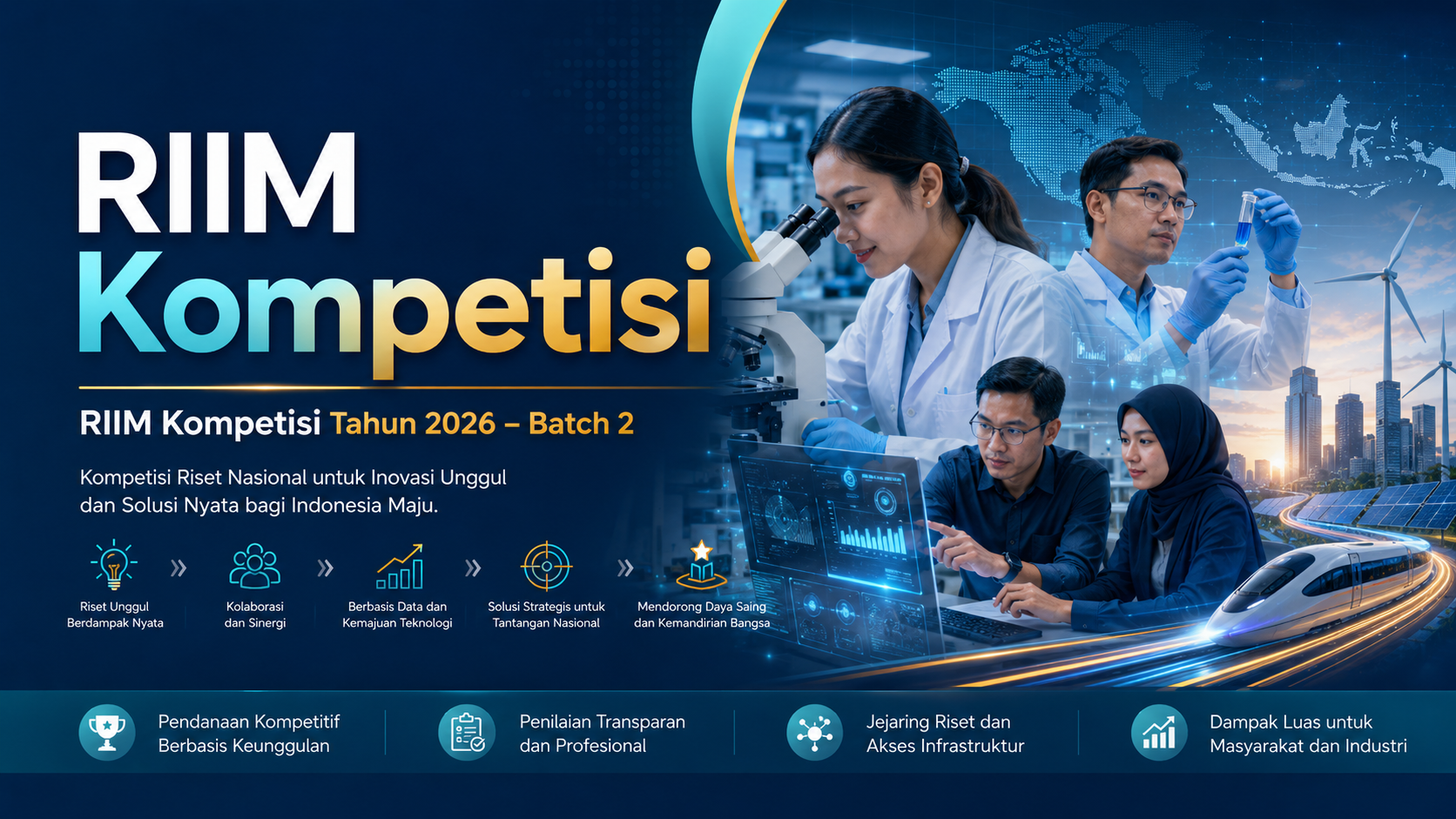
Riset dan Inovasi untuk Indonesia Maju, commonly known as RIIM Kompetisi, is a research-funding scheme managed by BRIN together with LPDP to support studies that produce scientific and technological novelty and have the potential for further development by relevant stakeholders. The program allows researchers from universities, research institutes, research organizations, businesses, and other eligible institutions to propose basic or applied research that is aligned with national development needs. Its main emphasis is placed on the quality of the research question, defensible novelty, methodological rigor, team capability, and the likelihood that the study will generate reputable publications, intellectual property, databases, prototypes, models, or new knowledge with practical value. Funding may be provided on a multi-year basis in accordance with program rules and annual performance evaluation. Applicants must therefore prepare a phased and realistic research plan with measurable annual milestones. The batch-based submission system introduced for 2026 makes the proposal cycle more structured and requires applicants to align the readiness of documents, institutional approval, and online submission with the announced batch period.
A RIIM Kompetisi proposal should coherently explain the state of the art, research gap, scientific contribution, measurable objectives, methodological design, division of responsibilities, facility requirements, data-management plan, expected outputs, risks, and budget. The principal investigator and team members must demonstrate relevant competence and track records, while the proposing institution should confirm administrative support and access to research facilities. Proposals that merely repeat previous studies or promise routine outputs without clear novelty are generally less competitive. In contrast, submissions addressing strategic problems and supported by strong theoretical foundations, replicable methods, preliminary evidence, collaborative networks, and a logical utilization pathway are more persuasive. The budget must also correspond directly to annual activities and outputs because the continuation of funding may depend on milestone evaluation. Beyond the scientific proposal, teams are encouraged to prepare ethical clearances, permits, partner commitments, and data-governance arrangements at an early stage. With adequate preparation, RIIM Kompetisi can serve not only as a source of research financing but also as a mechanism for building productive, collaborative research groups capable of generating sustained scientific and practical impact.