

Event Detail
- Start Date 03/12/2025
- Start Time 12:00 AM
- End Date 29/12/2025
- End Time 11:00 PM
- Location INDONESIA
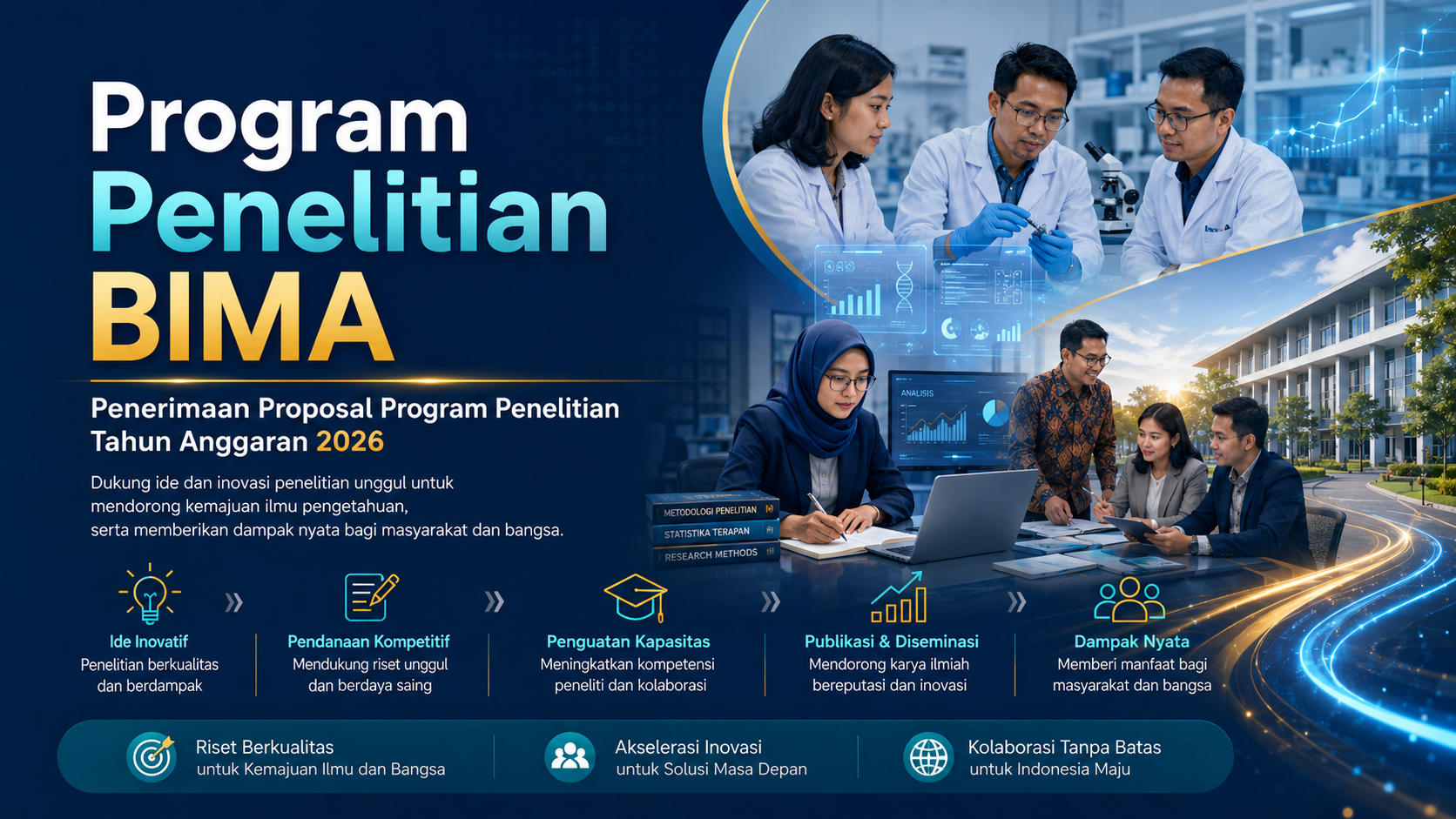
Program Penelitian BIMA is a Kemdiktisaintek funding agenda intended to improve the quality, productivity, and relevance of research conducted by university lecturers. For the 2026 funding year, the program includes basic and applied research schemes tailored to researchers’ career stages, institutional characteristics, and expected outputs. The available schemes include Penelitian Dosen Pemula, Penelitian Tesis Magister, Penelitian Disertasi Doktor, PMDSU, Penelitian Fundamental, inter-university cooperation, and applied research producing models or prototypes. This diversity enables early-career lecturers to build a track record, postgraduate students to accelerate thesis and dissertation research, established research groups to develop scientific novelty, and universities to move selected outputs toward practical application. The program also functions as part of the national research-ecosystem development process through SINTA profiles, university clustering, reviewer assessment, monitoring, and reporting through the BIMA system.
Applicants must select a scheme that is genuinely compatible with their academic rank, degree, research track record, supervised-student status, university cluster, team size, project duration, and output requirements. The proposal should consistently present a focused title, abstract, background, state of the art, novelty, roadmap, method, schedule, division of tasks, budget, and output plan. Researcher information in BIMA and SINTA should be checked well in advance because inconsistencies in identity, affiliation, publications, or proposal status can prevent successful submission. After registration, the university research office verifies and approves the proposal before it enters the national selection process. Assessment covers not only topic attractiveness but also objective measurability, methodological adequacy, budget reasonableness, team competence, and the likelihood that outputs will be achieved. Applicants should avoid unrealistic lists of outputs and select targets appropriate to their capacity. Awarded teams must implement the project according to contract, retain financial evidence, upload progress information, participate in monitoring and evaluation, and complete all reports and promised outputs.