
Event Detail
- Start Date 15/06/2026
- Start Time 12:00 AM
- End Date 03/09/2026
- End Time 03:00 PM
- Location INDONESIA
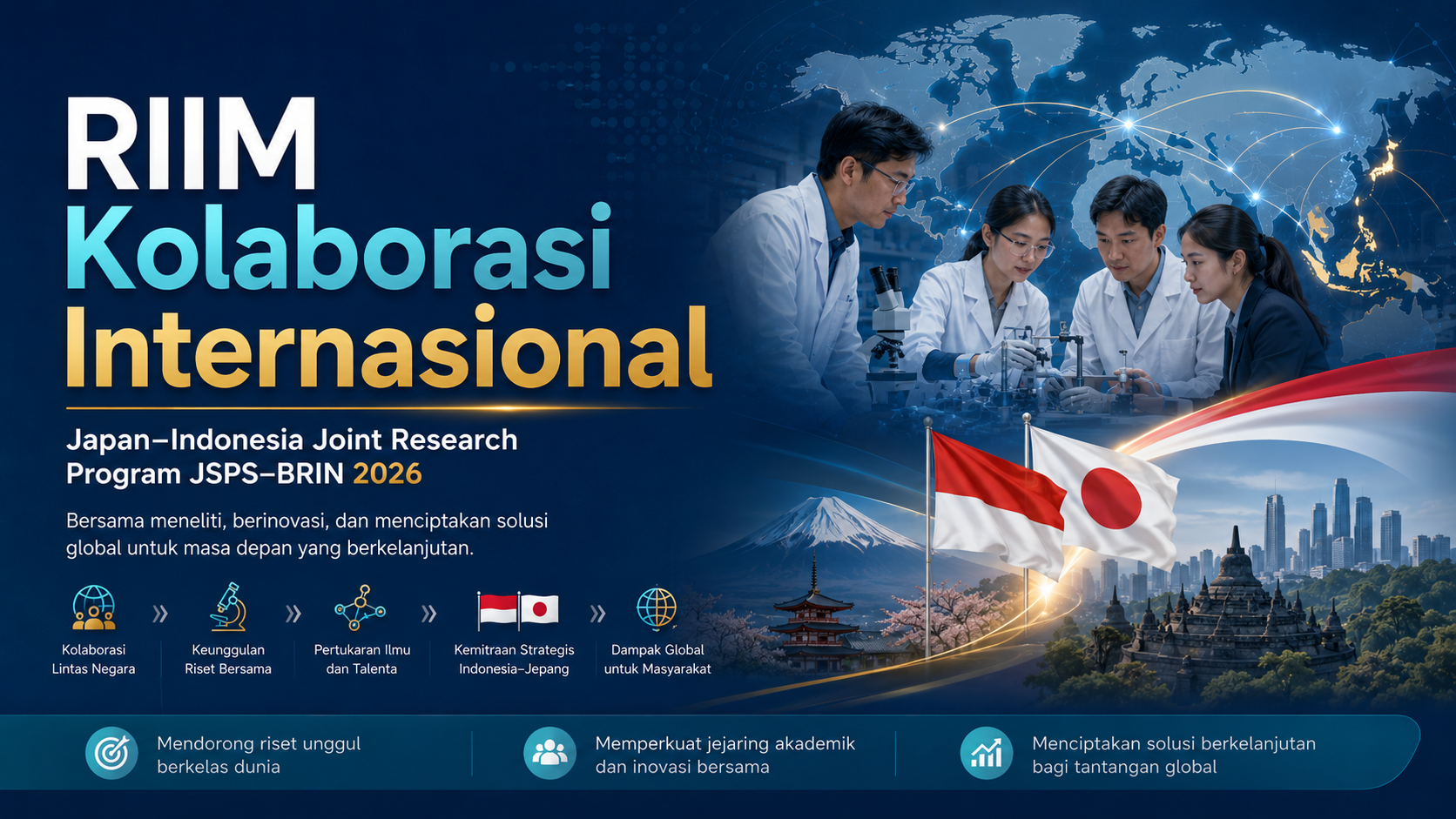
RIIM Kolaborasi Internasional through the Japan–Indonesia Joint Research Program between JSPS and BRIN provides an opportunity for Indonesian and Japanese researchers to conduct joint projects built on scientific equality and the shared interests of both countries. The program covers a broad range of disciplines, including natural sciences, technology, social sciences, and the humanities, and is intended to strengthen institutional networks, researcher mobility, methodological exchange, access to facilities, and the development of early-career researchers. Its value extends beyond project financing because it is expected to generate new knowledge, joint publications, seminars, researcher exchanges, and other mutually relevant outcomes. Proposals must be submitted as a matched pair: the Indonesian principal investigator applies to BRIN, while the Japanese principal investigator submits through the JSPS system. Both proposals must present aligned work plans, identical objectives, clearly divided responsibilities, and consistent schedules. A submission made by only one party cannot be processed, making communication and document synchronization between the two research teams a fundamental requirement.
The Indonesian team should select a Japanese partner with complementary expertise, a relevant track record, and a clear commitment to implementing the joint activities throughout the project period. A strong proposal explains why the research requires cross-country collaboration, the comparative advantages of each team’s facilities and expertise, the mechanism for researcher exchange, data management, ownership of results, publication plans, and the continuity of collaboration after funding ends. Budgets for the Indonesian and Japanese sides follow the respective funding-agency rules and should support eligible activities such as mobility, scientific meetings, experiments, and other permitted research costs. Applicants should also anticipate earlier internal deadlines imposed by their home universities or institutions. The title, abstract, objectives, duration, and activity structure in both proposals must be checked carefully for consistency. In addition to publication targets, the team is encouraged to include early-career researcher development, follow-on grant applications, and long-term international-network utilization so that the collaboration can mature into a sustained and productive partnership.